


Quantitative Transition Risk Assessment for Financial Institutions
Aligned with RBI's Disclosure Framework, TCFD, and NGFS scenarios, EnDecarb.ai provides the analytical engine to compute climate-adjusted financial risks.
The Regulatory & Strategic Pillars
Our framework aligns with global regulatory guidance and Reserve Bank of India expectations, addressing the key drivers of transition risk:
Policy & Regulatory Risk
Impact of carbon pricing, emissions trading systems (ETS), and evolving climate regulations.
Technological Disruption
Adoption of low-carbon technologies and risks from the phase-out of carbon-intensive assets.
Market Dynamics
Shifting consumer preferences and demand patterns affecting revenues and competitiveness.
Reputational & Strategic Risk
Changing investor expectations, ESG scrutiny, and implications for access to capital.
From Integrated Models to Financial Risk Intelligence
We employ a sophisticated six-stage downscaling methodology to translate global climate pathways into portfolio-level financial risk insights:

IAM & Transition Pathways
Integration of Integrated Assessment Models (IAMs) and global literature to project carbon pricing, policy shifts, and macroeconomic pathways across multiple climate scenarios and time horizons.
Asset-Level Overlay (Financed Emissions)
Mapping counterparty-level emissions (Scope 1, 2, and 3) against transition pathways to identify carbon-intensive and risk-exposed assets.
Transition Vulnerability Index (TVI)
Inhouse developed scoring framework assessing counterparties based on emissions intensity, sector exposure, and transition capacity under evolving policy, technology, and market conditions.
Model Ensembling & Calibration
Combining multiple scenario frameworks (NGFS, IEA, ECB) and calibrating them with India-specific macroeconomic variables, energy mix trajectories, and policy signals.
Financial Impact & Credit Risk Translation
Quantifying impacts on revenues, costs, and capital expenditure, and translating these into climate-adjusted probability of default (PD) and credit risk metrics.
Portfolio Aggregation & Transition Risk Database
Centralizing outputs into a unified database to enable portfolio-level insights, sectoral risk concentration analysis, and scenario-based stress testing.
Key Features of the Tool
Advanced Stress Testing & PD Modeling

Climate-Adjusted Financials
Generate projected balance sheets and P&Ls for corporates under multiple climate scenarios.
PD Stress Testing
Quantify how transition costs (energy mix shifts, carbon taxes) impact a counterparty's Probability of Default (PD).
 Consistency across reports
- Reduced manual effort
- Faster turnaround
Energy Mix Trajectories
Sector-specific modeling of energy consumption, renewable adoption, and brown-energy phase-outs.
Macro-Variable Pathing
Integrated pathways for inflation, interest rates, and commodity prices influenced by climate shifts.
Global Applicability
While grounded in ECB's economy-wide methodology, our tool is fully customized for Indian and global markets using all NGFS scenarios.
Portfolio Risk Intelligence
Gain a comprehensive, portfolio-level view of transition risk with decision-ready insights across sectors, geographies, and scenarios:

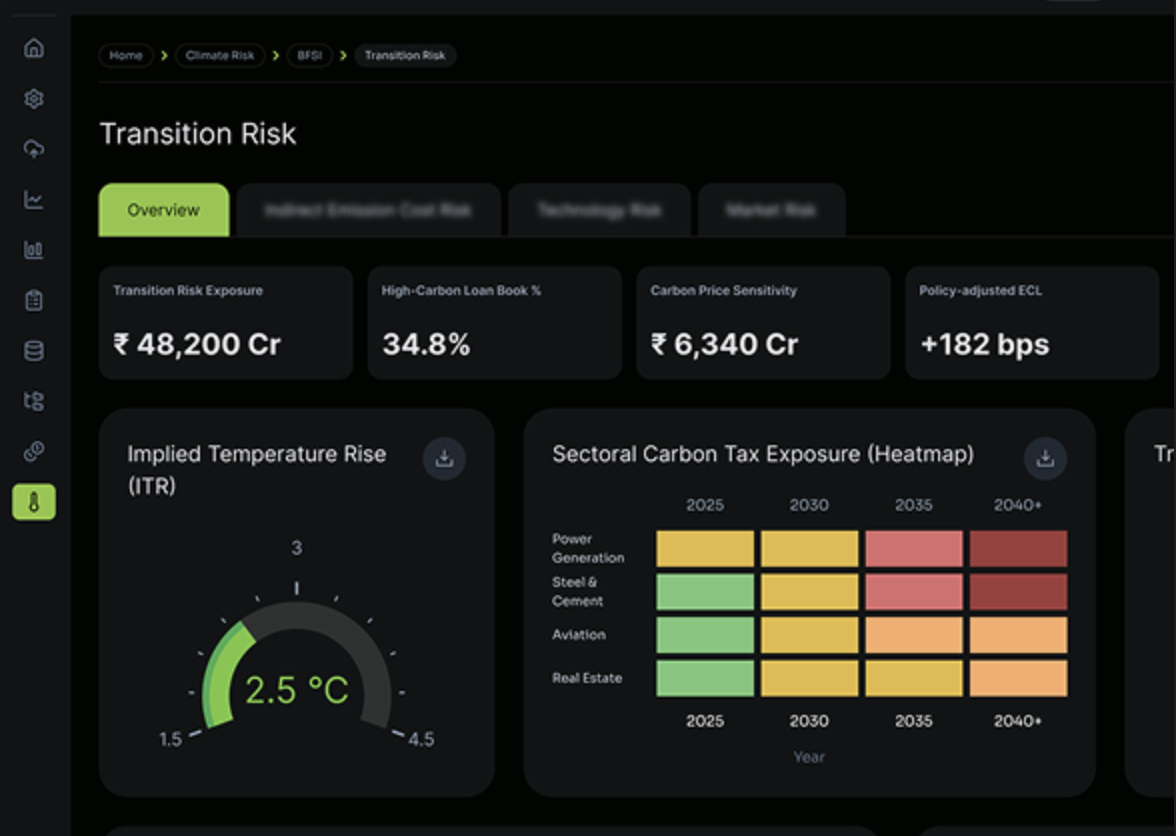
Sectoral Heatmaps
Identify high-risk exposures across sectors such as cement, steel, and power, with clear visibility into concentration and vulnerability.
Scenario Comparison
Analyze portfolio performance under multiple climate pathways, including Orderly, Disorderly, and Hot House World scenarios, across different time horizons.
Climate-Adjusted Risk Metrics
Track changes in probability of default (PD), credit risk, and exposure at risk under each scenario.
Country & Sector Aggregation
View risk distribution across geographies and industries to identify concentration risks and diversification opportunities.
Drill-Down Analytics
Navigate from portfolio-level insights to sector, counterparty, and asset-level risk drivers.